


Secret Classrooms - An Untold Story Of The Cold War
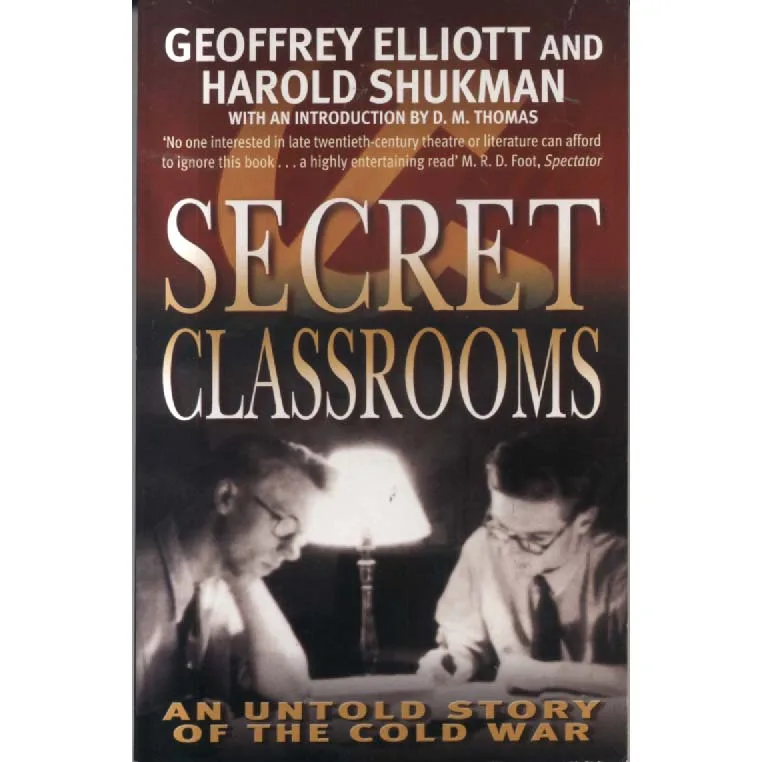
Publisher: St Ermins Press
Format: Paperback
ISBN: 9781903608135
Small bibliographical note: this was co-written by Geoffrey Elliott and Harold Shukman, although some listings credit Elliott alone.
The Cold War was not fought entirely by trench-coated spies exchanging microfilm beneath dripping railway bridges. Some of it took place in chilly classrooms, where bewildered National Servicemen attempted to master Russian verbs while quietly wondering how cleaning boots and conjugating the future perfect would prevent the collapse of Western civilisation.
In Secret Classrooms, Geoffrey Elliott and Harold Shukman uncover the remarkable story of the Joint Services School for Linguists, established when the British authorities realised that keeping an eye on the Soviet Union would be considerably easier if somebody could understand what the Soviets were saying. The solution was wonderfully British: identify thousands of bright young conscripts, send them to camps at places including Coulsdon, Bodmin and Crail, and teach them intensive Russian under conditions designed to make Siberia seem faintly welcoming.
Between 1951 and 1960, around 5,000 National Servicemen passed through this peculiar Cold War institution. Many were trained to translate intercepted communications for signals intelligence; others were prepared for interpretation, interrogation and related activities that officials preferred not to discuss over tea. The Soviet press denounced the establishment as a spy school, which was unfair only in the sense that it was also a grammar school with uniforms, military discipline and rather more knowledge of tank components than the average sixth form.
The teaching was rigorous, the testing relentless and the consequences of failure alarmingly practical: students who could not cope might be returned to ordinary military duties. Faced with the choice between mastering Russian declensions and being sent somewhere to march through mud, the human brain apparently became astonishingly receptive.
The instructors included émigrés from Russia and Eastern Europe, many of whom had first-hand experience of the world their pupils were being trained to monitor. Their classrooms brought together displaced intellectuals, reluctant servicemen, future intelligence specialists and a surprisingly distinguished collection of young men who would later become major figures in British cultural life.
Among the school’s alumni were Alan Bennett, Michael Frayn, Dennis Potter, historian Martin Gilbert and theatre director Peter Hall. Evidently, if the object was to defeat Soviet communism, Britain’s secret weapon was to train a generation of playwrights to pronounce “tractor factory” with impeccable accuracy.
Drawing upon memories, archival research and the recollections of former students, Elliott and Shukman recreate a forgotten corner of National Service in which military absurdity existed alongside genuine intellectual achievement. The students endured inspections, regulations and institutional discomfort, yet many emerged able to read, translate and interpret a notoriously difficult language after an extraordinarily concentrated period of study. It was immersive learning, helped along by the useful educational incentive that one’s alternative career involved rifles.
The book also shows how profoundly the experience shaped its graduates. Some went into intelligence, diplomacy or academia; others carried Russian literature and culture into publishing, journalism, broadcasting and the theatre. What began as an urgent national-security programme produced an informal network of linguists whose influence spread through post-war British life—rather more successfully, perhaps, than most committees established by the Ministry of Defence.
Secret Classrooms is part military history, part collective memoir and part account of an educational experiment that would now require seventeen consultations, a safeguarding policy and a motivational app. It captures both the seriousness of the Cold War and the peculiarly makeshift character of Britain’s response: immense geopolitical danger addressed through National Service, strong tea and vocabulary tests conducted in converted military buildings.
This is an engaging choice for readers interested in espionage, signals intelligence, National Service, Russian studies or the strange machinery of post-war Britain. It is not a catalogue of glamorous undercover operations, but the story of the people who supplied the vital linguistic skills behind them—the men who listened, translated and occasionally discovered that an ominous burst of Soviet radio traffic concerned nothing more sinister than agricultural production figures.
The result is an affectionate, informative and often amusing history of an institution that was officially important, widely misunderstood and subsequently almost forgotten. It proves that one of the Cold War’s quieter battlefields contained no missiles at all, only chalkboards, irregular verbs and young conscripts desperately trying not to be transferred somewhere less educational.
This copy is in Good condition, meaning it has experienced ordinary signs of previous ownership but remains sound, presentable and fully capable of teaching its next reader how Britain prepared for ideological Armageddon through accelerated language tuition. Offered by Crappy Old Books, whose own intelligence network has successfully located another excellent book despite operating under a name calculated to discourage enemy interest.
Keep browsing: See more War books Other books by Geoffrey Elliott
